
Book Review: TJ Power's DOSE Effect
- May 2
- 5 min read
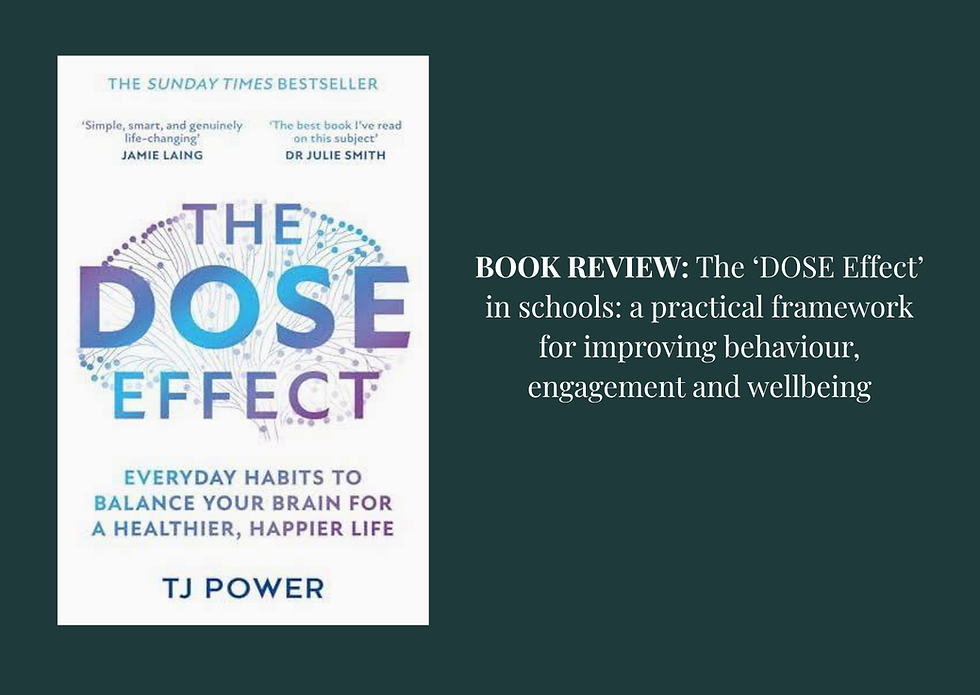
If you’re seeing more dysregulation, lower motivation, and sharper swings in mood, you’re not imagining it. Many schools are working harder than ever - strengthening relationships, tightening systems, and adding interventions - yet still finding that everyday regulation is harder to sustain.
In The DOSE Effect, TJ Power offers a useful lens for understanding why. He suggests that modern life is disrupting the brain chemistry that underpins motivation, connection, stability and resilience. DOSE refers to four key neurochemicals: dopamine, oxytocin, serotonin and endorphins. Together, they influence how young people engage, relate, cope and persist.
The core idea is simple but powerful. Many young people are now experiencing an excess of “fast dopamine”, quick, high-frequency rewards from phones, gaming and constant novelty, while receiving far less of the slower, stabilising inputs that come from real connection, predictable routines and physical movement. In schools, this imbalance doesn’t stay theoretical. It shows up in patterns of behaviour: low engagement, high volatility, shutdown, conflict, or a constant search for stimulation. This isn’t about excusing behaviour. It’s about responding with greater precision and designing environments that support regulation, rather than expecting pupils to demonstrate self-control when their nervous system is already depleted.
What DOSE Looks Like in the Classroom
1. Dopamine: “Why won’t they try?”:
Dopamine plays a central role in motivation, effort and goal-directed behaviour. When pupils are accustomed to rapid, high-intensity rewards outside of school, the slower gratification of classroom learning can feel underwhelming by comparison.
In practice, this often presents as disengagement framed as apathy - pupils expressing “What’s the point?” or avoiding tasks altogether. Staff may notice procrastination, work refusal, or a constant pull towards distraction, particularly through phones or other stimuli. A common pattern is uneven effort: high energy and focus when something is immediately interesting, but minimal engagement when it requires sustained attention.
The shift here is not to rely solely on distant or abstract rewards such as future success or long-term pride. Instead, classrooms need to make progress visible and immediate. Breaking learning into achievable steps, highlighting success in real time, and creating regular moments of completion can help rebuild the link between effort and reward.
2. Oxytocin: “They’re surrounded, but disconnected”
Oxytocin is associated with trust, bonding and a sense of social safety. While young people may be constantly connected digitally, this does not reliably translate into feeling safe or secure in relationships particularly for those already experiencing insecurity or heightened sensitivity to shame.
In school, low oxytocin often presents through defensiveness and relational fragility. Pupils may interpret correction as targeting, respond quickly with “You’re picking on me,” or withdraw after feedback. There may be increased peer conflict or subtle relational aggression, alongside behaviours that test boundaries as a way of checking whether adults are consistent and safe.
The practical implication is that connection is not an optional extra but a core part of regulation. When warmth is paired with predictability, the perceived threat level drops, making cooperation more likely. Consistent adult responses, clear repair processes, and visible relational safety help pupils remain engaged even when challenged.
3. Serotonin: “Everything feels like a threat”
Serotonin supports mood stability, confidence and a baseline sense of security. Factors such as poor sleep, chronic stress and constant social comparison can reduce this baseline, leaving pupils more vulnerable to emotional volatility.
In the classroom, this often looks like heightened reactivity. Pupils may become irritable or tearful with little warning, respond intensely to relatively small triggers, or struggle to recover after feedback. Shame responses can escalate quickly, and what might appear as defiance is often an attempt to manage overwhelming emotional states.
The key shift here is recognising that stability is not achieved through individual effort alone. It is built through environment. Consistent routines, predictable responses, and systems that are experienced as fair and transparent all contribute to a sense of safety. Over time, this reduces reactivity and supports more measured responses.
4. Endorphins: “They can’t cope with stress”
Endorphins play a crucial role in stress relief and resilience. They are naturally increased through movement, physical exertion and moments of shared positive experience such as laughter. However, more sedentary, screen-heavy lifestyles mean many pupils are not accessing these regulatory benefits regularly.
In school, low endorphin levels can present as overwhelm and reduced tolerance for challenge. Pupils may shut down quickly, express “I’m done” at the first sign of difficulty, or become increasingly restless during long periods of sitting. This restlessness can escalate into disruption or conflict when it is repeatedly contained without release.
The practical shift is to view movement not as a reward for good behaviour, but as a necessary component of regulation. Incorporating opportunities for physical activity, structured breaks, and sensory resets can help pupils maintain engagement and manage stress more effectively.
Turning Insight into Action:
The strength of the DOSE framework is that it gives schools tangible levers to pull. It shifts the focus away from waiting for external factors to change and towards designing environments that actively support regulation. This begins with reducing unnecessary exposure to “fast dopamine.” Clear and consistently enforced phone boundaries can significantly reduce distraction and attention fragmentation. Where possible, limiting constant device reliance in learning helps pupils rebuild focus. Alongside this, attention itself can be taught as a skill , starting with short, manageable periods of focus and gradually extending them over time.
At the same time, schools can intentionally increase real connection. Protecting tutor time as a relational anchor, rather than allowing it to become purely administrative, creates space for meaningful interaction. Strengthening repair routines ensures that conflict does not become identity, while distributing responsibility for care across teams prevents reliance on a single “heroic” adult and creates a more stable support network for pupils.
Predictability is another critical lever. When schools develop a shared language for emotions, conflict and repair, and ensure that routines are consistent across classrooms, uncertainty is reduced. Transparent behaviour processes that protect dignity help pupils understand what will happen and why, reducing perceived threat and increasing trust.
Finally, building movement into the structure of the day supports both engagement and resilience. This goes beyond timetabled PE. Incorporating active breaks, opportunities for physical reset, and targeted support for pupils who struggle with long sedentary periods can significantly improve regulation across the school day.
Where This Aligns with Navigate’s Approach
This framework closely aligns with Navigate’s core premise: behaviour and wellbeing are environmentally driven and biologically mediated. Schools do not need more blame. They need better design. By embedding clear systems, predictable routines and consistent relational safety, schools can create environments where regulation is more likely, engagement is more sustainable, and both staff and pupils are better supported to succeed.


Comments